K-pop isn't just music; it's a dynamic cultural phenomenon, constantly evolving, shape-shifting, and setting new trends. Trying to understand its trajectory without a roadmap can feel like chasing a moving target. That's why defining K-pop generations and criteria isn't just an academic exercise—it's essential for anyone wanting to grasp the genre's incredible journey, from its foundational beats to its current global dominance. These generational markers help us pinpoint key shifts in sound, style, marketing, and the very fabric of how idols connect with their audience.
From the pioneering artists who fused Western sounds with Korean flair to today's digital natives crafting metaverse concepts, each era reflects specific artistic innovations and deep sociocultural transformations within South Korea and, increasingly, worldwide. It's a story of constant reinvention, where yesterday's groundbreaking concept becomes tomorrow's established norm.
At a Glance: What You'll Learn About K-Pop Generations
- The Genesis: How Seo Taiji and Boys laid the groundwork for modern K-pop by combining music, visuals, and social messages.
- The Idol System's Birth: The First Generation's focus on domestic dominance, mysterious concepts, and the systematization of the trainee model.
- Global Foundations: The Second Generation's "Golden Age," marked by hook songs, synchronized dancing, and the first deliberate steps into international markets.
- Worldwide Phenomenon: How the Third Generation, fueled by social media, crafted intricate "universes" and shattered global barriers.
- Performance & Digital Mastery: The Fourth Generation's rise during a pandemic, emphasizing high-level performance, musical experimentation, and virtual engagement.
- The Vibe Shift: The emerging Fifth Generation's embrace of AI, "auditory music," and a return to "easy listening" with a Y2K aesthetic.
- Beyond the Music: How K-pop's evolution impacts fandom culture, fashion, beauty, and even global interest in the Korean language.
More Than Dates: The Criteria Shaping K-Pop's Eras
What truly defines a K-pop generation isn't just a block of years. Instead, it's a confluence of specific characteristics that delineate major shifts in the industry. Think of these criteria as the DNA of each era:
- Music & Production Styles: From genre fusions like hip-hop and rock to the rise of "hook songs," EDM, and hyper-pop.
- Visual Concepts & Fashion: Evolving from color-coded outfits to intricate storytelling, "girl crush" aesthetics, luxury brand ambassadorships, and Y2K nostalgia.
- Promotional & Marketing Methods: Shifting from broadcast TV and physical albums to digital singles, YouTube, social media, survival shows, and virtual concerts.
- Technological Developments: The impact of internet access, smartphones, streaming platforms, AI, and metaverse integration.
- Market Focus & Global Reach: Progression from domestic dominance to targeting specific Asian markets, then a full-fledged global strategy.
- Sociocultural & Artistic Innovation: Reflecting broader societal trends, addressing mental health, and continuously pushing creative boundaries.
Understanding these intertwined elements helps you see why K-pop is such a dynamic and resilient cultural force.
The Genesis: Laying the Foundation (Early 1990s)
Before "idols" as we know them, K-pop was incubating. The real turning point arrived on April 11, 1992, with the debut of Seo Taiji and Boys. This wasn't just another group; it was a cultural earthquake. They weren't trained in the modern idol system, but their impact was undeniable.
Seo Taiji and Boys unapologetically infused Western music genres—hip-hop, rock, New Jack Swing, rap, and breakdance—into the Korean mainstream. Their music, delivered with Korean lyrics and elaborate choreography, dared to incorporate social critique, a rarity at the time. Tracks like "I Know" and "Come Back Home" weren't just catchy; they resonated with a burgeoning youth culture, proving teenagers were a powerful consumer market. This pioneering trio established a foundational philosophy for K-pop: Music + Visuals + Message. It was a formula that would be refined and systematized for decades to come.
First Generation: The Idol System Takes Root (1996-2004)
Following Seo Taiji's retirement, the nascent K-pop industry needed a new direction. Enter SM Entertainment, founded by Lee Soo-man. SM systematized what would become the cornerstone of K-pop: the "Trainee System." This era saw the birth of the idol archetype—groups meticulously trained in singing, dancing, and performance.
The First Generation largely focused on domestic dominance, though some groups made initial forays into Japan and China. Concepts were often shrouded in mystery and fantasy, and fan culture began to bloom with color-coded fandom balloons, creating distinct visual identities for each group.
- H.O.T. (High-five Of Teenagers): Often credited as the first true K-Pop idol group, they debuted in 1996. They tackled social issues like school violence, leaving a significant cultural footprint with songs like "Candy."
- Sechs Kies: H.O.T.'s fierce rivals, known for their strong stage presence and dynamic performances.
- S.E.S. (Sea, Eugene, Shoo): SM's first successful girl group, embodying a mystical "fairy" concept that captivated audiences.
- Fin.K.L (Fine Killing Liberty): Known for alternating between innocent and more mature concepts, this group launched the career of Lee Hyori, who would become an iconic solo artist.
- g.o.d (Groove Over Dose): Dubbed the "Nation's Group," they cultivated a more approachable, boy-next-door image that endeared them to a wide audience.
This era solidified the idol group as a commercial and cultural force, setting the stage for bigger ambitions.
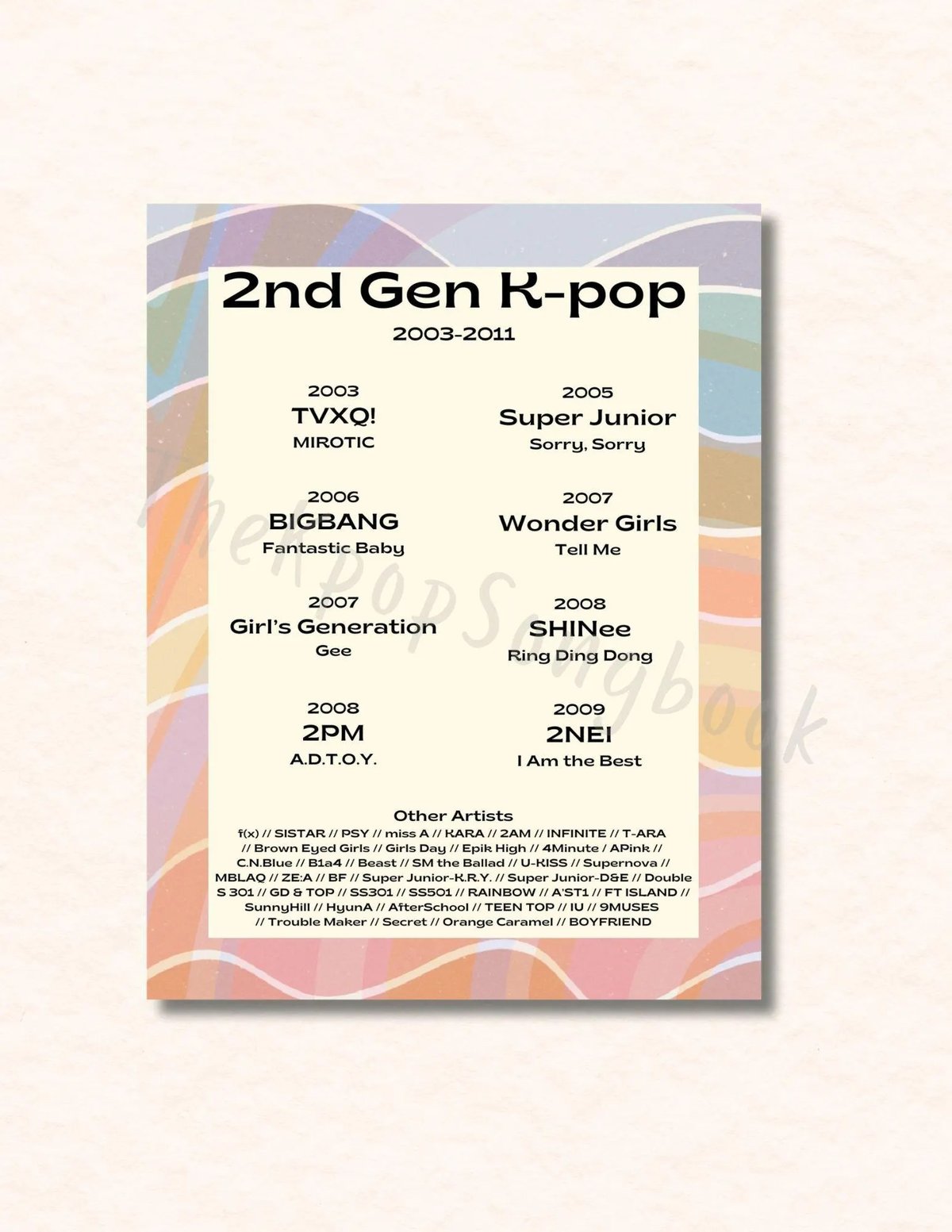
Second Generation: Hallyu's First Wave & The Golden Age (2005-2012)
Many fans and industry experts consider the Second Generation the "Golden Age" of K-pop. Training systems were perfected, leading to incredibly polished groups ready for the spotlight. Crucially, this generation actively targeted overseas markets, laying the essential groundwork for what would become the global phenomenon known as Hallyu (the Korean Wave).
Defining characteristics included the widespread adoption of the "Hook Song"—catchy, repetitive choruses designed to get stuck in your head—and incredibly precise, synchronized group dancing (Kalgunmu). The industry also began its pivot from physical albums to digital singles, reflecting broader technological shifts.
- TVXQ! (DBSK/Dong Bang Shin Ki): Known as the "Emperors of K-Pop," they were instrumental in cracking the Japanese market, becoming the first Korean group to perform at the iconic Tokyo Dome with hits like "Mirotic."
- Super Junior: Pioneers of the large-group concept, known for their variety show presence and strong performances.
- Girls’ Generation (SNSD): The "Nation’s Girl Group," their infectious song "Gee" sparked a global cover dance craze, establishing them as an international powerhouse.
- BIGBANG: Often called "Artist-Idols," they blurred lines between idol and artist, incorporating hip-hop and high fashion, with hits like "Lies" and "Haru Haru."
- 2NE1: YG Entertainment's powerful girl group, known for their fierce "girl crush" concepts and strong vocals.
- Wonder Girls: Made history as the first K-pop group to enter the US Billboard Hot 100 with their catchy retro hit "Nobody."
This generation proved that K-pop had universal appeal and could transcend language barriers, planting the seeds for its global explosion.
Third Generation: K-Pop Goes Global (2013-2018)
If the Second Generation laid the groundwork for Hallyu, the Third Generation ignited the global explosion. This era coincided perfectly with the smartphone and social media revolution, enabling groups to build direct, intimate relationships with international fans via platforms like YouTube and Twitter.
This generation introduced complex storytelling, intricate "universes," and lore within their music and concepts. Survival shows became a popular method for group debuts, building fan engagement from the ground up. YouTube views soared, effectively dissolving the barrier between "K-Pop" and "Global Pop." Musically, K-pop developed a unique, hybrid style, freely combining diverse genres like trap, hip-hop, and electronic pop, truly breaking free from overt Western influence to forge its own distinct sound.
- BTS (Bangtan Sonyeondan): Broke virtually every ceiling, pioneering deep narratives with their "School Trilogy" and "HYYH" (Most Beautiful Moment in Life) series, which openly addressed mental health and self-love. Songs like "Spring Day" became cultural touchstones, and later hits like "Dynamite" and "Butter" cemented their global superstar status.
- BLACKPINK: Defined the "Girl Crush" concept, becoming global luxury brand ambassadors. Their distinctive sound and striking visuals, exemplified by "DDU-DU DDU-DU," made them a worldwide fashion and music icon.
- EXO: Introduced sophisticated "World Building" with superpower concepts and intricate narratives, captivating fans with tracks like "Growl."
- TWICE: Popularized "Color Pop," known for their bright, energetic, and incredibly catchy songs like "Cheer Up" and "TT," radiating pure joy.
The Third Generation made K-pop an undeniable force on the world stage, transforming it from a niche genre into a mainstream cultural phenomenon.
Fourth Generation: Performance Redefined & Digital Dominance (2019-Present)
Emerging just before and during the challenging COVID-19 pandemic, the Fourth Generation adapted and thrived in an increasingly digital world. This era is characterized by strong musical experimentation, pushing boundaries with hybrid genres like EDM, rock, and trap. It also saw an accelerated reliance on online concerts and virtual fan interactions, solidifying K-pop's digital presence.
What truly stands out is the incredibly high performance level—groups often combine demanding choreography with live vocals, pushing the limits of what's expected. This generation has also seen a powerful resurgence and redefinition by girl groups, who often lead with bold, confident, and powerful concepts.
- Stray Kids: Known for their self-producing prowess and "Mala taste" music—intense, experimental, and uniquely their own.
- ATEEZ: Praised for their powerful performances and compelling lore, building a strong global fanbase.
- ITZY: Embodying a confident "Dalla Dalla" (different different) message, known for their vibrant energy and powerful dance breaks.
- TXT (TOMORROW X TOGETHER): Explores youth narratives and fantasy concepts with a unique pop sound.
- aespa: Broke new ground with a metaverse concept, integrating virtual "ae" avatars into their artistry and showcasing a distinct hyper-pop sound.
- IVE: Introduced a "narcissism concept" focused on self-love and confidence, quickly rising to prominence with sleek visuals and catchy tracks.
- THE SSERAFIM: Known for their strong "fearless" concepts and sharp, impactful choreography.
- (G)I-DLE: A self-producing group celebrated for their diverse musical styles and powerful storytelling, often participating in songwriting and concept creation.
The Fourth Generation continues to innovate, proving K-pop's adaptability and enduring appeal in a rapidly changing world.
Fifth Generation: The Vibe Shift & Digital Natives (Emerging since 2023)
As the Fourth Generation continues to flourish, a new "vibe shift" is undeniably underway, signaling the emergence of the Fifth Generation. These artists are truly digital natives, integrating advanced technologies like artificial intelligence and virtual concerts more deeply into their promotional strategies and content creation. There's a noticeable trend towards "Easy Listening"—songs designed for comfortable, repeated listening in playlists, without necessarily requiring elaborate visuals.
This often comes with a strong "Y2K Nostalgia" aesthetic, a callback to late 90s and early 2000s fashion and sound. The emphasis is returning to "Auditory Music," prioritizing the sonic quality and emotional resonance of a track. Idols are increasingly involved in generating their own content, fostering an even deeper connection with their highly engaged fanbases.
- ZEROBASEONE (ZB1): A popular boy group formed through a survival show, embodying the fresh, digital-native appeal.
- RIIZE: YG Entertainment's new boy group, garnering attention for their "emotional pop" sound and sleek visuals.
- BOY NEXT DOOR: Delivering a casual, approachable, and relatable concept, focusing on youthful experiences.
- KISS OF LIFE: A girl group praised for their strong vocal performances and mature, confident image.
- NewJeans: This group arguably shattered previous formulas and largely signaled the "vibe shift." They revitalized 90s R&B sounds and introduced a natural, "girl-next-door" aesthetic that resonated widely. Songs like "Hype Boy" and "Ditto" became emblematic of the "easy listening" trend, demonstrating that powerful, impactful music doesn't always need high-concept visuals to succeed.
The Fifth Generation is actively exploring new musical territories and ultra-connected promotional strategies, ensuring K-pop remains at the forefront of global pop culture.
Beyond the Eras: How K-Pop Continues to Evolve
K-pop's generational shifts are symptoms of broader industry transformations that continually redefine its impact.
From Visual Music to Auditory Revival
For much of its history, K-pop was synonymous with "Visual Music." Intricate choreographies, high-budget music videos, and stunning concepts were paramount. While these elements remain crucial, there's a discernable shift towards "Auditory Music" in the latest generations. This means songs are increasingly crafted for pleasant, comfortable repeat listening on playlists, sound good on the radio, and hold up sonically even without the visual spectacle. It's a recognition that while the visuals draw you in, the music keeps you coming back.
Fandom Power: From Consumers to Co-Creators
The K-pop fandom has transformed dramatically. Once largely passive consumers, fans have evolved into active "Producers." This involves organizing streaming parties, running sophisticated fundraising campaigns for album purchases or charity, and diligently translating content for international audiences. This hyper-engaged, organized fanbase serves as the backbone of the industry's marketing machine, effectively becoming partners in a group's success. Their dedication drives trends, fuels engagement, and extends the reach of K-pop far beyond official channels.
K-Pop as a Cultural Ambassador
The global rise of K-pop acts as a primary driver for the global expansion of other Korean cultural elements. This phenomenon, often called the "K-Culture effect," manifests in several ways:
- Hangeul (Korean Alphabet): Increased global interest in K-pop leads directly to more people wanting to learn Korean, often starting with Hangeul.
- K-Beauty & K-Fashion: Idols are trendsetters. Their hairstyles, makeup, and outfits dictate global beauty and fashion trends, making Korean brands highly sought after.
- K-Food: When idols consume Korean dishes on live streams or variety shows, it sparks worldwide curiosity and boosts K-Food exports, from instant ramen to traditional meals.
K-pop isn't just about entertainment; it's a powerful engine for soft power, driving appreciation and engagement with Korean culture across the globe.
Common Questions About K-Pop Generations
You've got questions about these shifting timelines and labels—that's normal! Here are some common queries and clarifications.
Why do generation dates sometimes vary?
K-pop generation dates aren't officially declared by a central authority. They're informal classifications, often debated among fans, journalists, and industry insiders. The start and end points are usually marked by major shifts in industry trends, debut of influential groups, or technological advancements rather than a specific calendar date. This natural fluidity means you might see slight variations, but the core characteristics of each era generally remain consistent.
Is a group always confined to one generation?
Generally, a group is associated with the generation in which they debuted. However, highly influential groups, especially those with long careers, can transcend or significantly impact subsequent generations. For example, some Second Generation groups continued to innovate and adapt their music, influencing Third Generation trends. The impact of a group can certainly last beyond its "home" generation.
What's the biggest misconception about K-pop generations?
A common misconception is that newer generations are inherently "better" or completely erase the influence of previous ones. In reality, each generation builds upon the foundations laid by its predecessors. What one generation innovated, the next refined and globalized. The evolution is cumulative, not always a complete overhaul, and appreciation for earlier generations is often central to understanding K-pop's rich history.
Navigating K-Pop's Ever-Changing Landscape
Understanding K-pop generations isn't about rigid classification; it's about appreciating the genre's dynamic journey. From the groundbreaking beats of Seo Taiji and Boys to the metaverse concepts of today's digital natives, K-pop continually reinvents itself, reflecting technological shifts, cultural currents, and an unyielding commitment to artistic innovation.
As you explore the vast world of K-pop, recognize that its past informs its present, and its present is already shaping its future. This ever-evolving landscape ensures there's always something new and exciting to discover, making K-pop not just a genre, but a vibrant, living story told through music, visuals, and undeniable passion.